
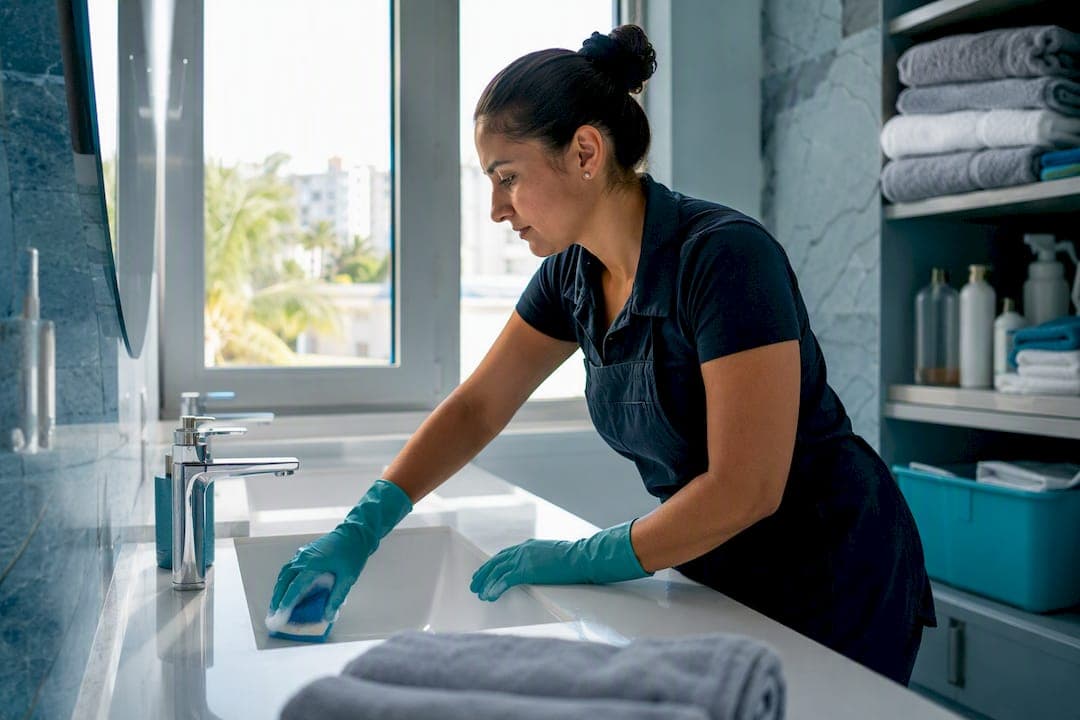
Turnover cleaning is the full reset of a rental between one guest's checkout and the next one's check-in: cleaning, laundering, restocking, inspecting, and staging the space to match the listing photos. It's a time-sensitive job, usually finished within a few hours, and it's different from a deep clean, which is a periodic, more thorough service that tackles the grime a quick reset can't touch.
TL;DR:
- Turnover cleaning requires strict adherence to a room-by-room checklist, including sanitizing, restocking, and inspecting for damage, to avoid negative reviews.
- Deep cleaning involves scheduled tasks like grout scrubbing and appliance interior cleaning, performed every three to six months to prevent grime buildup.
- Same-day turnovers demand at least four to five hours of buffer, pre-staged supplies, and photo verification to ensure timely, consistent service.
- Costs typically range from $95 to $300 per visit, depending on unit size, turnaround urgency, linen services, and staging requirements.
- Hiring professional turnover services enhances reliability, documentation, and liability coverage, especially for high-volume or same-day schedules.
Table of Contents
- What Does Turnover Cleaning Include? A Room-by-Room Breakdown
- Turnover Cleaning vs. Deep Cleaning: What's the Real Difference?
- How Long Does a Turnover Take, and How Do You Handle Same-Day Turns?
- What Does Turnover Cleaning Cost, and Who Pays for It?
- How to Build a Turnover Cleaning Operation That Doesn't Fail
- When Should You Schedule a Deep Clean?
- How Do You Handle Health and Safety Standards During Turnovers?
- Is Hiring a Professional Turnover Service Worth It?
- Book a Turnover That Actually Shows Up on Time
- Sources
What Does Turnover Cleaning Include? A Room-by-Room Breakdown
A turnover isn't a light dusting between guests. It's a defined checklist that has to happen the same way every time, because a missed step turns into a review that costs you a future booking.
Here's what a proper turnover covers, room by room:
- Bathroom: Sanitize counters and fixtures, scrub the toilet and shower, restock toilet paper and toiletries, and check for slow drains or running toilets.
- Kitchen: Wipe down counters and appliance exteriors, clear the fridge of anything left behind, and restock basics like dish soap and coffee filters.
- Bedrooms: Strip every bed, inspect mattresses and linens for stains or damage, and remake with fresh sheets.
- Living areas and floors: Vacuum and mop, dust high-touch surfaces like remotes and light switches, and empty all trash.
- Laundry: Wash every towel and sheet that touched a guest, even if it looks clean, since guest expectations don't allow for guesswork.
- Inspection and staging: Check for damage, take inventory of items, and reset décor to match your listing photos exactly.
Pro Tip: Keep a laminated copy of your checklist in a kitchen drawer at the property. Cleaners work faster with a physical reference than a phone app buried in notifications.
Turnover Cleaning vs. Deep Cleaning: What's the Real Difference?
Turnover cleaning and deep cleaning solve two different problems, and confusing them is how hosts end up with a property that looks fine in photos but smells musty by month three.
A turnover is reactive and guest-driven: it happens every time someone checks out, takes one to three hours, and focuses entirely on getting the unit guest-ready again. A deep clean is scheduled, not triggered by a checkout, and runs every three to six months to handle the buildup a turnover crew simply doesn't have time for, according to Hostfully's turnover research.
Tasks that belong exclusively to deep cleaning include:
- Scrubbing grout and tile lines
- Cleaning inside appliances (oven, fridge coils, dishwasher filter)
- Vent and baseboard dusting
- Upholstery and mattress deep-cleaning
- Window tracks and light fixtures
The two services work together, not against each other. Turnovers keep the property guest-ready week to week; deep cleans reset the baseline so every future turnover starts from a genuinely clean foundation instead of papering over grime that's crept in. Skip the deep clean long enough, and even a flawless turnover checklist won't stop the complaints. For a closer look at where the line actually falls, see deep clean vs. standard clean.
How Long Does a Turnover Take, and How Do You Handle Same-Day Turns?
Duration depends almost entirely on square footage and how the last guest left the place. Smaller units often take about an hour or so, medium-sized ones require more time, and larger or fully featured rentals need additional cleaning time, with variability depending on property complexity.
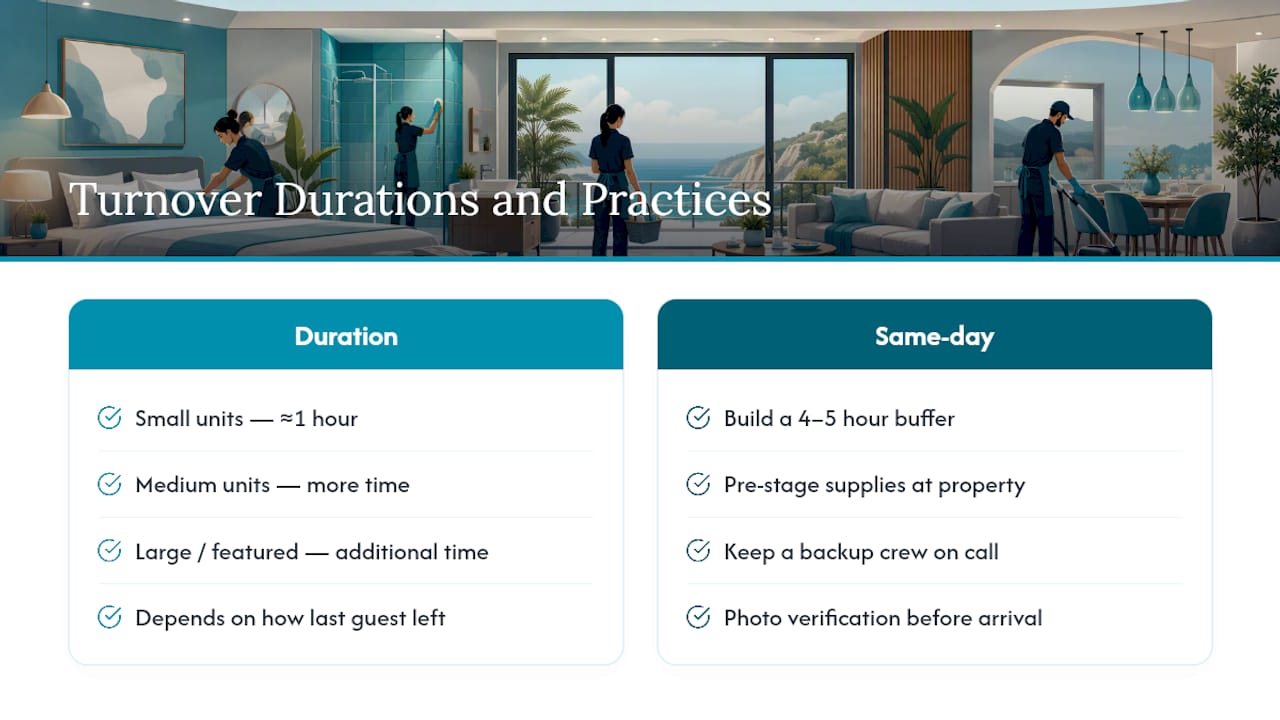
Same-day turns are where things go wrong fastest. Operators who succeed at them build in a 4 to 5 hour buffer between checkout and check-in, pre-stage supplies at the property instead of hoping a cleaner brings enough towels, and keep a backup crew on call for the day something runs long.
Photo verification before guest arrival closes the loop. A cleaner who texts finished photos of the made beds and staged kitchen gives you proof the job's done before the next guest ever walks in, which matters more the further you live from the property.

What Does Turnover Cleaning Cost, and Who Pays for It?
Turnover pricing swings based on unit size, timeline pressure, and what's included. Market pricing for Miami-area short-term rental turnovers commonly falls between $95 and $300 per visit, with same-day turns and full linen service pushing toward the higher end.
Factors that move the price:
- Square footage and number of bathrooms
- Same-day turnaround versus next-day
- Linen laundering included versus outsourced
- Staging and restocking of consumables
Most hosts build the turnover fee into a separate cleaning fee charged to the guest rather than absorbing it into the nightly rate. That keeps your listed price competitive in search results while still covering costs, though some hosts absorb it to appear cheaper upfront and rely on volume to make up the difference.
The cleaning cost accumulates significantly with frequent turnovers, so hosts should calculate expenses based on their monthly turnover volumes and typical per-turnover fee to budget appropriately. Run that number before you set your nightly rate. If a cleaner finds damage during a turnover, document it with photos immediately. Most hosts recover the cost through the platform's damage protection or a security deposit rather than eating the loss.
How to Build a Turnover Cleaning Operation That Doesn't Fail
A checklist alone doesn't protect you from a bad review. What protects you is a system where the checklist, the photos, and the schedule all talk to each other.
Start with a standard checklist tied directly to your listing photos, not a generic template pulled off the internet. If your listing shows a specific throw pillow arrangement or a folded-towel display, the checklist should say so explicitly. Vague instructions produce inconsistent results.
Finished-photo verification is the piece most hosts skip until they get burned once. Require cleaners to text or upload photos of the made beds, staged kitchen, and bathroom before marking the job complete. Run occasional QA audits, showing up unannounced or reviewing photos against a random sample, to catch drift before it becomes a pattern.
If you manage more than a couple of units, connect your booking calendar to a task-management tool so cleaner assignments happen automatically the moment a checkout posts. Automated scheduling cuts the lag between checkout and cleaner notification, which matters most on tight same-day turns.
- Pre-stage a backup kit of towels, toilet paper, and coffee at the property so a cleaner never has to make a supply run mid-turnover.
- Train cleaners on time-boxing: 15 minutes per bathroom, 20 per bedroom, so the whole job stays predictable regardless of who's on shift.
Pro Tip: Ask your cleaning service for a same-day text confirmation with photos attached. It takes them thirty seconds and saves you a frantic call from a guest standing outside a locked door.
When Should You Schedule a Deep Clean?
Plan a deep clean every three to six months as a baseline, then move sooner if you spot specific triggers: stubborn stains that survive a turnover, signs of pests, or a high-season stretch coming up where back-to-back bookings won't leave room for a mid-season reset.
Book deep cleans on gap days between guests rather than trying to squeeze one into a normal turnover window. A deep clean covers what turnovers structurally cannot, including appliance interiors, grout lines, HVAC vents, and upholstery. Skipping it doesn't show up immediately, but it shows up eventually, usually in a review mentioning a smell or a stain nobody bothered to explain.
How Do You Handle Health and Safety Standards During Turnovers?
Guest expectations around cleanliness shifted permanently after the pandemic, and turnover protocols haven't fully reverted. Hosts who treat sanitization as an afterthought now stand out in reviews, for the wrong reasons.
Post-pandemic industry guidance recommends heightened attention to high-touch surfaces, door handles, light switches, remote controls, faucet handles, during every turnover, not just during flu season. That means disinfecting these points every single turn, not wiping them with the same rag used on the counter.
Documentation matters more than it used to as well. Keeping a simple log of when sanitization steps happened, and by whom, gives you something concrete to point to if a guest ever raises a health complaint. It also protects your cleaning team: if a dispute comes up, a dated checklist beats a verbal "yes, we did that."
Ventilation is worth building into your routine too. Airing out a unit for even 15 to 20 minutes before a new guest arrives helps with lingering cleaning-product odors and general staleness, especially in units without strong HVAC circulation. None of this requires hospital-grade protocols. It requires consistency, which is the part most self-managed hosts underestimate until a guest mentions it in a review.
Is Hiring a Professional Turnover Service Worth It?
Here's where I land after looking at how this actually plays out: DIY turnovers work fine at low volume, one or two units, flexible checkout windows. Once you're running same-day turns, managing multiple properties, or living somewhere else entirely, the math shifts. A missed turnover isn't a minor inconvenience; it's a guest standing outside a locked door.
What a professional, insured team adds isn't just labor. It's documented photo verification, faster rebooking when something goes wrong, and liability coverage that a solo cleaner or a friend doing you a favor can't offer.
— Erik
Book a Turnover That Actually Shows Up on Time
If you're weighing DIY turnovers against a professional team, the deciding factor is usually reliability under pressure, and that's where Cleaning is built to hold up. Every turnover includes laundering, restocking, staging to match your listing photos, and finished-photo verification sent before your next guest arrives.
Same-day turns are handled with pre-staged supplies and backup crews on standby, so a tight checkout-to-check-in window doesn't turn into a scramble. Booking takes under 60 seconds online, no phone tag, no waiting for a callback. If you want a straightforward starting point, book a house cleaning and specify your turnover schedule during checkout, or request a quote directly through the vacation rental page for a recurring turnover plan tailored to your listing's turnover frequency.
Sources
For hosts who want to go further into cleaning protocols and industry standards, RentResponsibly's STR cleaning guidance covers baseline sanitation standards, while Hostaway's glossary breaks down scheduling terminology. OneFineBnB's turnover guide frames the operational stakes for hosts, and recommended.app's Miami cost guide offers current market pricing examples.
- Vacation Rental Turnover Cleaning: How to Nail Same-Day Turns (2026) | Hostfully
- What is Turnover? | Hostaway glossary
- Recommended