

Hire a housekeeper for ongoing household management, someone who shows up regularly and keeps the whole home running. Hire a maid or a cleaning service for periodic deep cleans and task-focused sanitizing. The two roles overlap more than people expect, and if you just want reliable, insured cleaning without managing an employee, a professional cleaning company usually beats hiring either one solo. The breakdown below covers duties, cost, and how to hire safely.
TL;DR:
- Hiring a professional cleaning company usually provides better reliability, insurance, and coverage for periodic deep cleans or time-specific needs than managing a maid or housekeeper personally.
- A maid focuses solely on cleaning tasks, while a housekeeper handles cleaning plus household management activities like laundry, errands, and supply management; scheduling frequency reflects the level of familiarity and trust.
- Costs vary based on service frequency, home size, experience, and whether the worker is live-in or live-out, with agencies typically including background checks and insurance in the rate.
- For ongoing household management needs, hire a housekeeper for regular presence and routine, but opt for a cleaning service when scheduling flexibility, guaranteed coverage, or equipment are priorities.
- When hiring directly, clearly define tasks, confirm references and insurance, and consider a trial period; professional services streamline this process with vetted, insured teams ready to start immediately.
Table of Contents
- Maid vs Housekeeper: Duties Compared
- How Often You'll See Them: Scheduling and Trust
- What It Costs: Pricing Models and What Drives the Price Up
- How to Hire Safely: Checklist and Questions to Ask
- When a Cleaning Service Beats Hiring Either One
- Where Cleaning.Miami Fits This Decision
- Does "Maid" Mean Something Different Around the World?
- A Simple Rule of Thumb for Making the Call
- Book an Insured Team Instead of Managing an Employee
- Sources
- FAQ
Maid vs Housekeeper: Duties Compared
The words get used interchangeably, but they describe different jobs. A maid (often called a house cleaner today) focuses almost entirely on cleaning: surfaces, floors, bathrooms, kitchens. A housekeeper takes on cleaning plus broader household management, closer to a part-time household manager than a cleaner who visits and leaves.
Typical maid duties:
- Dusting, vacuuming, mopping
- Bathroom and kitchen sanitizing
- Making beds and tidying rooms
- Taking out trash and light organizing
- Occasionally, window washing or appliance wipe-downs
Typical housekeeper duties, which usually include everything above plus:
- Laundry and ironing
- Meal prep or light cooking
- Grocery runs and household errands
- Managing supply inventories (paper goods, cleaning products)
- Overseeing general upkeep and sometimes coordinating other household help
The line blurs further with live-in versus live-out arrangements. A live-in housekeeper tends to absorb more responsibility over time, sometimes including light childcare support or pet care, simply because they're present daily. A live-out maid who visits twice a week rarely takes on that expanded role, because there isn't time or trust built up for it yet.
How Often You'll See Them: Scheduling and Trust
Housekeepers work on a set schedule, often daily or several times a week, which is what separates the role from occasional cleaning help. That regular presence is exactly what makes hiring a housekeeper different from hiring a cleaner: frequency builds familiarity, and familiarity is what lets you hand off more responsibility.
Maids and cleaners typically follow a less frequent schedule, with visits occurring weekly, biweekly, monthly, or for specific one-off events such as move-outs or post-renovation cleanups.
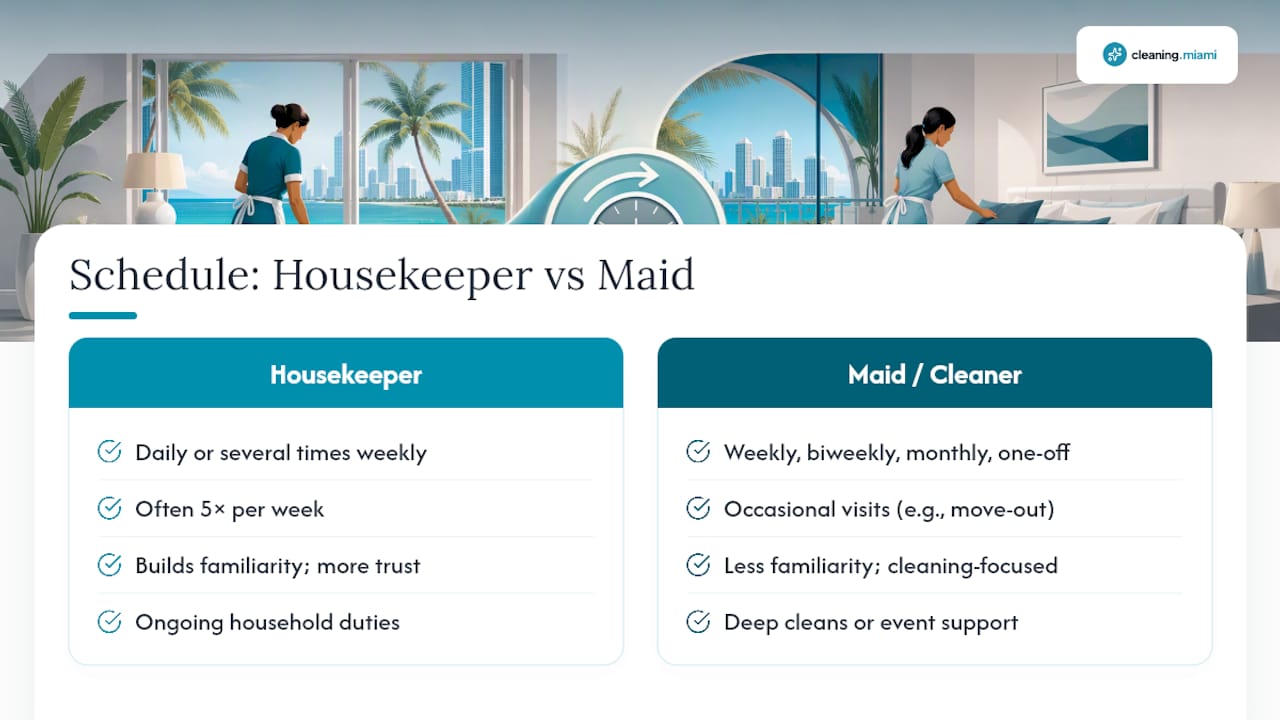
A housekeeper you see five days a week will eventually know where you keep the spare key and how you like your closets organized. A maid who visits once a month is there to clean, not to learn your household's rhythm. Neither is better. They're built for different kinds of trust, and you should match the schedule to what you actually need rather than defaulting to whichever sounds more traditional.
What It Costs: Pricing Models and What Drives the Price Up
Pay structures vary by role. Maids and cleaners are usually paid hourly or a flat per-visit rate. Housekeepers, especially live-in or full-time positions, are often paid a set salary, sometimes with room and board factored into live-in arrangements.
Several factors move the price beyond the base rate:
- How often you need service (daily service costs more than monthly, obviously, but per-visit rates often drop as frequency increases)
- Square footage and number of bathrooms, which drive labor time directly
- Whether the person is live-in (higher total cost, lower hourly equivalent)
- Experience level, language skills, and specialized tasks like laundry care for delicate fabrics
- Background checks, bonding, and insurance, which agencies and cleaning companies typically build into their rate
Frequency Callout: Hiring frequency is one of the clearest differentiators between the two roles. Housekeepers are engaged regularly, while maids and cleaners are commonly booked for one-off deep cleans or spaced-out maintenance visits. That single fact drives most of the pricing difference you'll see when comparing quotes.
How to Hire Safely: Checklist and Questions to Ask
Whether you're hiring a maid or a housekeeper directly, treat it like hiring any employee who'll have access to your home.
- Write down the exact scope: which rooms, which tasks, how often
- Set a schedule in writing, including start time and expected duration
- Ask for and actually call references, not just read them
- Confirm a background check has been run, either by you or the agency
- Verify insurance and, for live-in help, workers' compensation coverage
- Put the agreement in writing, covering pay rate, schedule, and termination terms
- Build in a short trial period, two to four visits, before committing long-term
Ask candidates directly: "What's your availability if I need to change the schedule?" "How do you handle access to areas I'd rather keep private?" "Can you provide two references from the last year?" Vague or defensive answers to any of these are a red flag worth taking seriously.
Pro Tip: Get the scope of work in writing before day one, even for a casual arrangement. "Light cleaning" means something different to every person, and a written list prevents the awkward conversation three weeks in about who forgot to clean the oven.
When a Cleaning Service Beats Hiring Either One
Some situations call for a cleaning company, not an individual. Vacation rental turnovers need guaranteed coverage between guests, not a maid who might call in sick before a same-day checkout. Post-renovation cleanup and seasonal deep cleans need equipment most individual hires don't own. Situations where a professional cleaning service wins:
- You need guaranteed coverage with a backup team if someone's out
- The job is a one-time deep clean or move-in/move-out clean
- You want equipment like HEPA-filtration vacuums for allergy-sensitive households
- You'd rather not manage payroll, scheduling, or a background check yourself
- You run a rental property and need fast, reliable turnover cleaning
A company can't replace the daily familiarity of a housekeeper. But for anything periodic or high-stakes, it removes the guesswork of vetting a stranger alone.
Where Cleaning.Miami Fits This Decision
For Miami-Dade households weighing this decision, a professional cleaning company can cover both ends without requiring you to become an employer. Teams are typically background-checked, insured, and bonded to handle the vetting step most people skip when hiring an individual directly. Services can span recurring maintenance cleaning (the housekeeper-style need) and one-time deep cleans or vacation rental turnovers (the maid-style need), with eco-friendly products suited to South Florida's humidity and salt air.
On the first visit, expect the team to walk the space, confirm the scope you set at booking, and get started. No interviews, no reference calls, no waiting on a background check to clear.
Does "Maid" Mean Something Different Around the World?
Terminology shifts sharply depending on where you are, and it's worth knowing before you post a job listing or search for help. In the United States, "maid" has fallen out of favor in professional contexts. Most agencies and cleaning companies now use "house cleaner" or "cleaning technician," partly because "maid" carries outdated connotations of domestic servitude that don't reflect the modern, professionalized version of the job.
In parts of the Middle East and Southeast Asia, "maid" still functions as the standard term for live-in domestic workers, often tied to formal visa sponsorship programs. The role there frequently includes childcare and eldercare on top of cleaning, a broader scope than the American use of the word suggests. In the UK, "cleaner" is the everyday term for periodic help, while "housekeeper" is reserved almost exclusively for live-in or full-time household management roles, often in larger homes or estates.
None of this changes the underlying comparison. It just means the label on a job posting tells you less than the actual duty list attached to it. If you're hiring, specify tasks and hours instead of relying on a job title to communicate what you actually need. A title means one thing in Miami and something else entirely in Dubai or London.
A Simple Rule of Thumb for Making the Call
If you want continuity and someone who learns your household's routines, hire a housekeeper. If you want periodic deep cleaning without the commitment of managing an employee, choose a maid, cleaner, or professional cleaning service. Most households overthink this decision when the honest answer usually comes down to one question: do you want a relationship or do you want a task completed well?
— Erik
Book an Insured Team Instead of Managing an Employee
A professional cleaning service is the alternative to hiring a maid or housekeeper directly when you'd rather skip the interviews, background checks, and payroll paperwork entirely. Teams are usually background-checked, insured, and bonded before entering your home, and the same crew can handle a one-time deep clean this week and recurring maintenance next month.
Whether you need weekly upkeep, a move-out deep clean, or fast turnover between Airbnb guests, the scope gets set at booking so there's no ambiguity about what's included. If your household runs on eco-friendly products or you're managing Miami's humidity and salt air, that's already built into the service. Get a quote for house cleaning in Miami-Dade and see available time slots in under a minute.
Sources
For readers who want to go deeper on specific pieces of this decision, a few sources are worth bookmarking. The CDC's guidance on cleaning and disinfecting covers when sanitizing matters most, such as during illness in the household. The EPA's explanation of HEPA filtration is useful context if a service advertises improved air quality. For duty and role definitions, Charles MacPherson's housekeeper-versus-cleaner breakdown is one of the clearer industry explanations available.
- Should I hire a house cleaner or housekeeper? | Angi
- Housekeeper vs. Maid: What’s the Difference? | Staffing at Tiffanie's
- What is a HEPA filter? | EPA
FAQ
What Is a Maid Called Now?
Most agencies and companies in the U.S. now use "house cleaner" or "cleaning technician" instead of "maid," since the older term carries outdated connotations that don't match the professionalized role today.
How Much Does a Housekeeper Get Paid Per Month?
Pay varies widely by hours, live-in status, and location, so there's no single reliable national figure to quote. Get a direct quote based on your specific schedule and scope rather than relying on a general estimate.
How Often Should a Maid Clean Your House?
Many households book maids or cleaners on a weekly or biweekly basis for standard upkeep, with monthly visits for lower-traffic homes. The frequency depends on how quickly a space accumulates mess, rather than a fixed industry standard.
What's the Difference Between a Maid and a Housewife?
A maid is a paid worker hired to clean a home, while a housewife is an unpaid role referring to a woman who manages her own household. The two terms aren't comparable job categories, they describe entirely different relationships to the home.
Can a Housekeeper Cook Meals for the Household?
Yes, meal prep and light cooking are common housekeeper duties, unlike the cleaning-only scope typical of a maid role. This should be spelled out explicitly in the written agreement before the first day.
Is It Better to Hire an Individual or a Cleaning Company Like Cleaning.Miami?
An individual hire offers more personal continuity, while a company like Cleaning.Miami offers insured, background-checked teams with guaranteed coverage and no employer responsibilities on your end. For periodic deep cleans, turnovers, or anyone who wants to skip the vetting process, a professional service is typically the lower-risk choice.