

Before you pay anyone to clean your home, stop and run three checks: ask for a certificate of insurance, confirm the company background-checks its staff, and get a written, itemized estimate. If a cleaner pushes for cash only, wants full payment upfront, or can't produce proof of insurance on request, walk away. Those three checks catch most cleaning service scams before money changes hands.
TL;DR:
- Always verify a cleaning company's certificate of insurance by calling the insurer directly rather than just reviewing a PDF document.
- Avoid companies that demand full prepayment or cash only, as these are common signs of scams and lack a secure payment trail.
- Confirm that staff undergo background checks and ask whether the company uses employees or independent contractors, favoring the former for better oversight.
- Obtain a written, itemized scope of work and clear cancellation policies before booking to prevent bait-and-switch pricing or unmet expectations.
- Document any damages immediately with timestamped photos and contact the insurer to file a claim within 24 to 48 hours if necessary.
Table of Contents
- Cleaning Service Scams: The Red Flags That Give Them Away
- How to Vet a Cleaning Company Before You Book
- Safe Payment and Booking Practices Before You Hire
- If a Cleaning Company Scams You: What to Do Next
- Running a Trial Clean the Right Way
- What Real Accountability Looks Like in a Cleaning Company
- Real Cleaning Scam Cases and What They Teach You
- Why the Standard Advice Undersells the Insurance Check
- A Vetted Option If You Want to Skip the Guesswork
- Where to Verify a Cleaner or File a Complaint
- Sources
- FAQ
Cleaning Service Scams: The Red Flags That Give Them Away
Most cleaning service scams share the same handful of tells, and once you know them, spotting a bad actor takes about five minutes on the phone.
Cash-only demands top the list. A legitimate company wants a payment trail as much as you do, for tax and dispute reasons, so an insistence on cash or a payment app that can't be reversed is one of the clearest red flags when hiring a house cleaner. Suspiciously low quotes work the same way. A price that undercuts every other estimate by a wide margin usually isn't a bargain. It's the opening move in a bait-and-switch, where the real total climbs once the crew is standing in your kitchen listing "extras" that were never mentioned on the phone.
Watch for these operational warning signs during your first conversation:
- No certificate of insurance available, or the company hedges when you ask for one
- No online presence, no verifiable reviews, or reviews that all read like they were written the same day
- A different crew shows up every visit with no consistent point of contact
- No satisfaction guarantee or re-clean policy of any kind
- A vague answer when you ask what happens if something gets broken
Common red flags also include no background checks on staff and quotes that mysteriously grow once workers are inside your home, according to Sparkmaids' hiring guide. Any one of these alone might be a fluke. Two or three together mean you're talking to the wrong company.
How to Vet a Cleaning Company Before You Book
Treat the first phone call like an interview, because that's exactly what it is. Work through this order and you'll eliminate most scam cleaning company setups before you ever hand over a credit card.
- Ask whether staff are employees or independent contractors. Employees are easier to background-check consistently and usually indicate a more stable operation; a company that relies entirely on rotating gig workers has less oversight over who enters your home.
- Request a certificate of insurance (COI) and verify it. Ask for the insurer's name and policy number, then call the insurer directly to confirm the coverage is active and the limits are real, covering both general liability and workers' compensation, as recommended by National Cleaner Connect.
- Ask about bonding. A bond protects you from employee theft, which is a separate issue from insurance covering accidental damage — a legitimate company can explain the difference without hesitating.
- Ask how often staff are background-checked and whether that policy applies to every cleaner sent to your home, not just the ones hired last year.
- Call at least two references and read the negative reviews, not just the five-star ones. The Better Business Bureau recommends interviewing multiple companies and checking bbb.org for complaint patterns before you commit to any of them.
- Get the scope and price in writing, itemized by task, before the crew arrives.
- Confirm the cancellation policy and how complaints get handled, in writing, before you need either one.
You can start that vetting process with referrals from neighbors or local community groups rather than the first search result, since personal recommendations tend to carry more weight than an anonymous listing. If you're unsure how to read a company's online footprint, this guide to choosing a vetted cleaning provider walks through what a legitimate local operation looks like.
Pro Tip: Ask for the insurer's phone number, not just a certificate PDF. A scam operator can fake a document; they can't fake a live insurance agent confirming your policy is active.
Safe Payment and Booking Practices Before You Hire
A reasonable deposit is normal. Full prepayment for a job that hasn't happened yet is not, and it's one of the fastest ways to lose money to a cleaning company scam with no recourse.
Pay by credit card, ACH transfer, or a company-issued invoice, all of which leave a paper trail and give you dispute rights if the work never happens. Skip wire transfers, gift cards, or any request routed through a personal payment app instead of a business account.
Before you confirm a booking, your written agreement should spell out:
- The exact scope of the clean, room by room
- Pricing for any add-ons, so nothing gets invented on-site
- The cancellation window and any fee attached to it
- What happens if something is damaged or missed
Getting the scope in writing matters more than most homeowners realize, since a vague verbal quote is exactly what lets bait-and-switch pricing happen in the first place, per Sparkmaids. If you're evaluating a new provider, booking a single deep cleaning session first, rather than a recurring contract, limits your exposure while you judge the work.
If a Cleaning Company Scams You: What to Do Next
Evidence and speed matter more than anger here. Most companies give you a narrow window, often just 24 to 48 hours, to report damage or missed work before they'll consider a claim, so document everything the moment you notice a problem.
- Take time-stamped photos immediately and keep every receipt, text, and email exchange with the company.
- Email the company directly, in writing, describing the issue and requesting a specific remedy, whether that's a re-clean or reimbursement.
- File a claim with the company's insurer if damage occurred, and ask for a claim number so you can track it.
- Dispute the charge with your bank or card issuer if you paid by card and the company refuses to respond.
- File a complaint with the Better Business Bureau or your state's consumer protection office to create a public record, which also helps warn other homeowners.
- Consider small claims court for damage or non-refunded deposits below your state's filing threshold. Most small claims courts don't require a lawyer, and filing fees are usually modest.
If a company later disputes what happened, this guide on giving a cleaner feedback or letting them go has language you can adapt for that first email.
Running a Trial Clean the Right Way
Treat your first booking as an audition, not a commitment. A single trial clean typically costs a bit more than a recurring visit would, and that's normal. You're paying for information, not just a clean floor, and it's the best way to evaluate punctuality, thoroughness, and how carefully a crew handles your belongings before you commit to anything ongoing.
- Set a short checklist for the crew before they arrive: which rooms, which surfaces, any fragile items to flag
- Walk through afterward, or request photos if you can't be home
- Check commonly missed spots: baseboards, ceiling fans, behind appliances
- Report anything missed within the satisfaction guarantee window, with photos attached
Pro Tip: Leave one small, deliberate test spot, like a dusty windowsill, out of your instructions. How a crew handles the areas you didn't mention tells you more than how they handle the ones you did.
For guidance on what to leave out for the crew versus what to tidy yourself, see what to do before the cleaner arrives.
What Real Accountability Looks Like in a Cleaning Company
Every checklist item above maps to something a legitimate operator should already have in place. Background-checked staff address the risk of an unknown person having a key or alarm code to your home. Insurance and bonding address the risk of damage or theft going unreimbursed. A written satisfaction guarantee, with a defined re-clean window, addresses the risk of paying for work that wasn't finished. Fast, transparent online booking addresses the more mundane risk of dealing with a company that's hard to reach once something goes wrong.
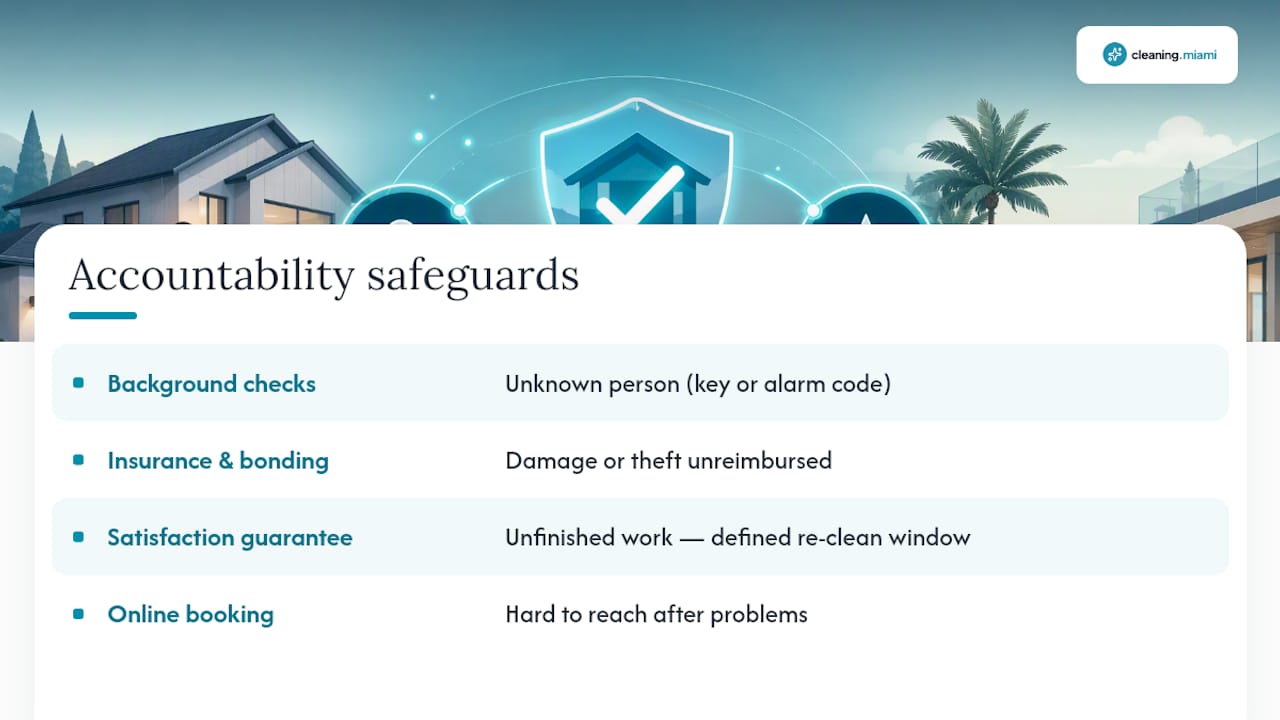
These aren't abstract features. They're the direct answer to each red flag covered above, and they're worth asking about by name, whatever company you end up hiring.
Real Cleaning Scam Cases and What They Teach You
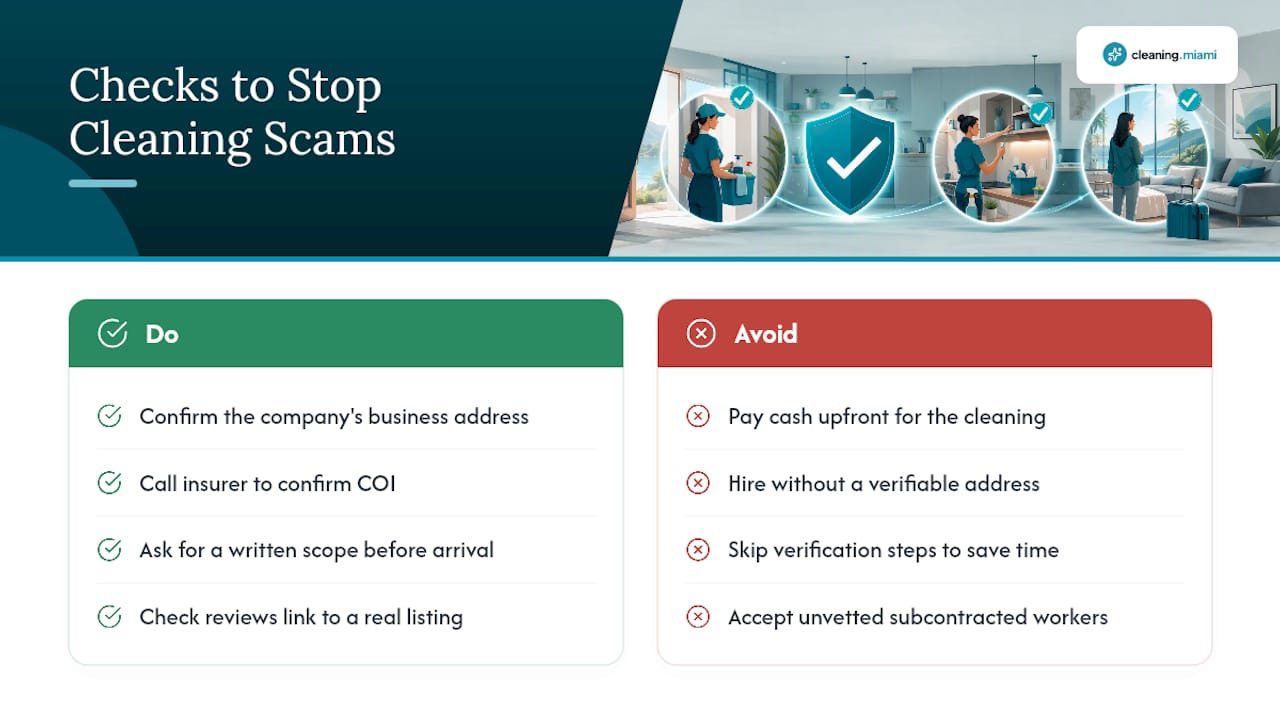
The scams that make local news follow a pattern. A homeowner books through a listing with no verifiable business address, pays cash upfront for a "discounted" deep clean, and the crew never shows, or shows up once and disappears with a deposit for supposed supply costs. In other reported cases, a legitimate-sounding company subcontracts to unvetted workers who then solicit cash tips directly and pressure customers into add-on services not in the original quote, a classic bait-and-switch.
The lesson in nearly every case is the same: the victim skipped a verification step that would have taken five minutes. No one called the insurer to confirm the COI was real. No one asked for a written scope before the crew arrived. No one checked whether the "hundreds of five-star reviews" were even tied to a real business listing.
None of these scams involve especially clever criminals. They involve homeowners in a hurry, which is exactly the position most people are in when they finally decide to hire help. The fix isn't more suspicion in general. It's a specific, repeatable set of checks applied every single time, regardless of how professional or friendly the person on the phone sounds.
Why the Standard Advice Undersells the Insurance Check
Most hiring guides bury the insurance verification step somewhere in the middle of a long checklist, treated as one item among many. That's backwards. Calling an insurer to confirm a policy is active takes about five minutes and closes off the single biggest source of financial exposure: a worker gets hurt in your home, or something expensive gets broken, and there's no coverage behind it.
The background check conversation gets more attention than it deserves relative to the insurance question, mostly because it's easier to ask about and sounds more dramatic. Both matter. But an uninsured company with perfectly screened staff still leaves you holding the bag if someone falls off a ladder in your living room.
If there's one habit worth building before your next booking, it's this: never take a certificate of insurance at face value. Make the call. It's the cheapest insurance policy you'll ever buy, and it's free.
— Erik
A Vetted Option If You Want to Skip the Guesswork
Cleaning is the alternative to hunting through unverified listings for a Miami cleaner.
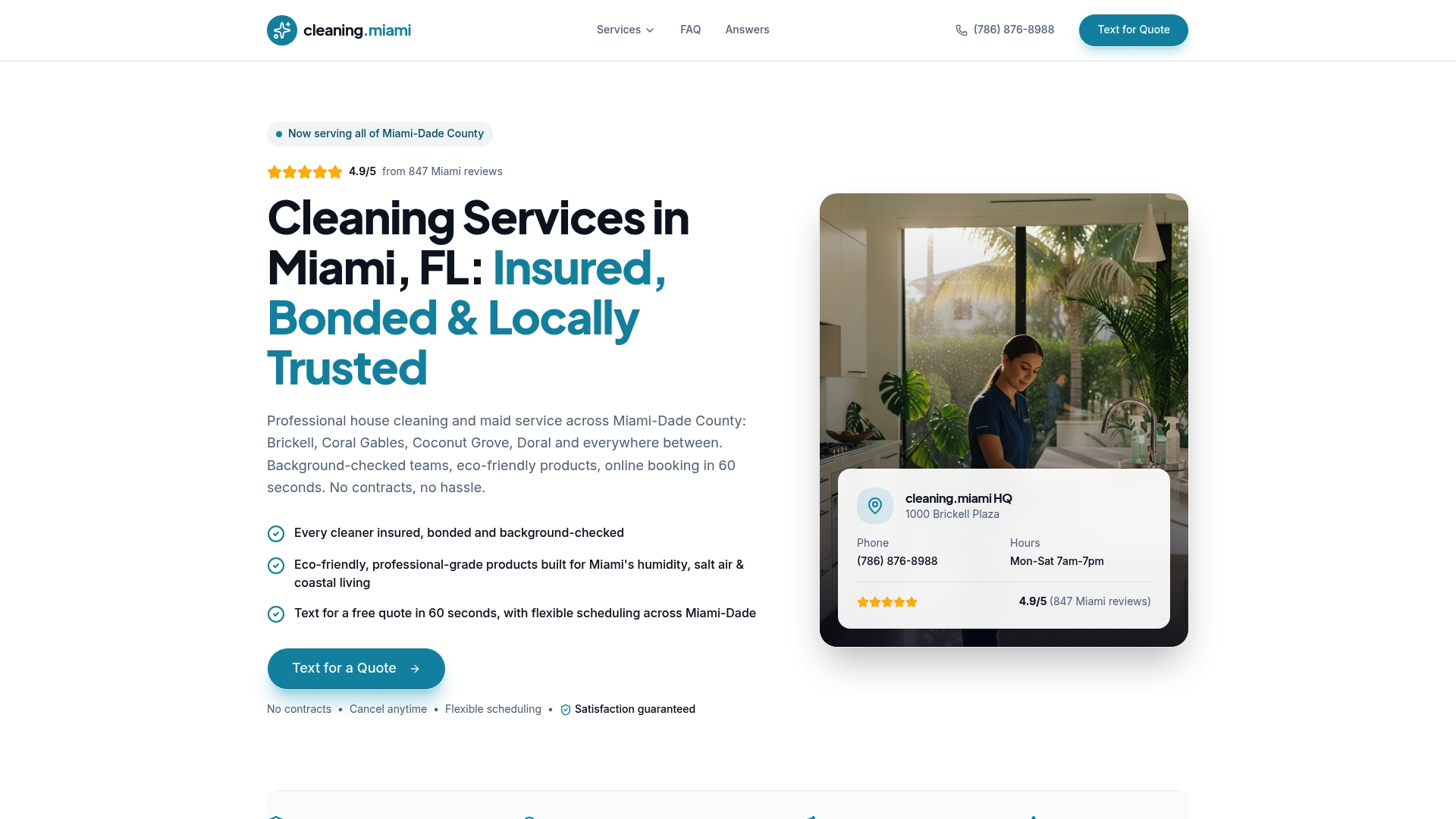
Booking is fast and flexible, with no contracts required. If you're looking for a one-time or recurring house cleaning service, need turnover cleaning between guests through Airbnb and vacation rental cleaning, or want your unit ready for a move with move-out and move-in cleaning, you can request a quote directly and see availability before you commit to anything.
Where to Verify a Cleaner or File a Complaint
Check any company's standing and complaint history through the BBB's cleaning service hiring tips before booking. If a job goes wrong, your state consumer protection office and small claims court handle disputes below a set dollar threshold without requiring a lawyer. For companies that market themselves professionally online, legitimate industry SEO practices are one sign of an operation built to last, not a fly-by-night listing.
Sources
- BBB: 7 tips for hiring a house cleaning service
- Business Insider: red flags when hiring a house cleaner
- How to find a reliable house cleaner (National Cleaner Connect)
- Sparkmaids: How to hire a house cleaner without getting burned
FAQ
How Do I Know If a Cleaning Service Is Legit?
Ask for a certificate of insurance and call the insurer to confirm it's active, then check whether staff go through background checks. A legitimate company answers both questions without hesitation and can produce documentation on request.
What Should I Do If a Cleaner Damaged My Property?
Take time-stamped photos immediately and email the company in writing describing the damage. Most companies require a claim be reported within 24 to 48 hours, and if they don't respond, you can dispute the charge through your bank or file a complaint with the BBB.
Is It Normal to Pay a Deposit for a Cleaning Service?
A modest deposit is common, but full prepayment before any work is done is a red flag. Pay by credit card or invoice so you retain dispute rights if the job doesn't happen as promised.
How Much Does Cleaning.Miami Cost?
Pricing varies based on the size of the home and the type of cleaning service requested. Current rates are available directly through the House Cleaning page when you request a quote.
What's the Difference Between Bonding and Insurance for a Cleaner?
Insurance covers accidental damage to your home during a cleaning visit, while a bond protects you specifically against employee theft. Ask any company for both before booking, since one doesn't substitute for the other.